

A DUI checkpoint on a Friday night can feel like an intrusion—officers stopping every car, asking questions, and shining flashlights into vehicles. If you’ve been stopped at one, you may wonder whether this practice is even legal. The short answer is yes: DUI checkpoints are legal in California, but only when law enforcement follows strict constitutional requirements. According to UC Berkeley SafeTREC (2025), 1,355 people died in alcohol-impaired traffic crashes in California in 2023 alone. Checkpoints exist as one tool to address this public safety crisis. However, the constitutional protections that limit government searches still apply, meaning not every checkpoint passes legal scrutiny.
This article explains the legal framework that governs DUI checkpoints in California, the specific requirements that make them constitutional, and what rights you retain when you’re stopped at one.
Are DUI Checkpoints Legal in California?
California courts have consistently held that properly conducted DUI checkpoints are constitutional under both the U.S. and California Constitutions. The California Supreme Court established the governing framework in Ingersoll v. Palmer, 43 Cal.3d 1321, 743 P.2d 1299 (Cal. 1987), which remains the controlling authority on checkpoint legality nearly four decades later.
Why did courts allow checkpoints without individualized suspicion?
Ordinarily, the Fourth Amendment requires police to have reasonable suspicion of criminal activity before stopping a vehicle. DUI checkpoints operate as a recognized exception to this rule. Courts have determined that the government’s interest in preventing drunk driving fatalities is substantial enough to justify brief, suspicionless stops—provided the checkpoint meets specific administrative safeguards.
The California DMV DUI Management Information System Report (2022) found that 31.8% of all traffic fatalities in California involved alcohol impairment. This significant public safety concern forms the constitutional justification for allowing checkpoint stops without individualized suspicion.
What makes checkpoint stops different from regular traffic stops?
A traditional traffic stop requires the officer to observe something specific—a traffic violation, erratic driving, or other articulable facts suggesting illegality. As the court explained in People v. Bell, 43 Cal.App.4th 754, 51 Cal. Rptr. 2d 115 (Cal. Ct. App. 1996), traffic stops based on mere hunches are insufficient.
Checkpoints bypass this requirement by substituting administrative safeguards for individualized suspicion. The trade-off is that checkpoints must follow rigid operational guidelines. When those guidelines aren’t followed, the constitutional exception doesn’t apply, and the stop may be deemed unlawful.

What Constitutional Standards Must California DUI Checkpoints Meet?
The Ingersoll v. Palmer decision established an eight-factor test that California courts use to evaluate whether a DUI checkpoint satisfies constitutional requirements. Not every factor carries equal weight, and courts consider the totality of circumstances, but significant departures from these standards can render a checkpoint unconstitutional.
What are the eight Ingersoll factors?
California law enforcement agencies must satisfy these requirements when operating DUI checkpoints:
- Supervisory-level decision making: Command-level personnel (not field officers) must determine the checkpoint’s location, time, and operational procedures. This removes discretion from individual officers and ensures standardized operations.
- Neutral, objective criteria for vehicle selection: Officers cannot select vehicles based on hunches, appearance of drivers, or vehicle type. A neutral formula (every car, every third car, etc.) must govern which vehicles are stopped.
- Adequate safety precautions: The checkpoint must include proper lighting, warning signs, clearly identifiable official vehicles, and uniformed officers. These measures protect both motorists and officers.
- Reasonable location: The checkpoint must be positioned where DUI incidents or accidents are prevalent, or where the location otherwise serves the checkpoint’s legitimate purpose.
- Reasonable time and duration: The checkpoint must operate during times when impaired driving is most likely and for a reasonable period. Operations during unusual hours without justification may be problematic.
- Advance publicity: Law enforcement should publicize the checkpoint in advance. While not strictly required for constitutionality, advance notice reduces the intrusiveness of the stop and serves the deterrent purpose.
- Indicia of official nature: The checkpoint must look official—marked patrol cars, uniformed officers, signs, and cones. Drivers must be able to recognize they’re approaching a legitimate law enforcement operation.
- Minimal detention time: Stops must be brief. Officers should quickly determine whether further investigation is warranted and release drivers who show no signs of impairment without extended delay.
How do courts evaluate whether a checkpoint met these requirements?
Courts apply a totality-of-the-circumstances analysis rather than a rigid checklist. A checkpoint that satisfies seven factors but has minor issues with one factor may still be constitutional. However, fundamental failures—such as allowing individual officers to select vehicles based on personal judgment or operating without supervisory planning—are more likely to invalidate the checkpoint.
What role does supervisory oversight play in checkpoint legality?
The requirement that supervisory personnel make operational decisions is among the most critical Ingersoll factors. This requirement exists to prevent arbitrary enforcement. When field officers make ad hoc decisions about where to set up, which cars to stop, or how long to detain drivers, the checkpoint loses its administrative character and begins to resemble the kind of discretionary stop that requires individualized suspicion.

What Happens If a DUI Checkpoint Violates Constitutional Requirements?
When a DUI checkpoint fails to meet constitutional standards, the evidence obtained during that stop may be subject to suppression under the Fourth Amendment’s exclusionary rule. This can include observations of impairment, statements made by the driver, field sobriety test results, and chemical test results.
Can evidence from an illegal checkpoint be thrown out?
Yes. If a court determines that a checkpoint stop violated the defendant’s Fourth Amendment rights, the remedy is typically exclusion of the evidence obtained as a result of that unlawful stop. Without the evidence from the checkpoint, prosecutors may be unable to prove their case.
The U.S. Supreme Court’s decision in Terry v. Ohio, 392 U.S. 1, 88 S. Ct. 1868 (1968), established that any investigative detention must be reasonably related in scope to the circumstances justifying the initial interference. A checkpoint that exceeds constitutional boundaries—whether through improper vehicle selection, excessive detention, or lack of supervisory control—may produce evidence that cannot be used at trial.
Who has the burden of proving the checkpoint was lawful?
In California, when a defendant challenges a checkpoint stop, the prosecution bears the burden of demonstrating that the checkpoint satisfied constitutional requirements. This means the government must be prepared to present evidence about how the checkpoint was planned, supervised, and operated. Incomplete records or absent supervisory testimony can undermine the prosecution’s ability to meet this burden.

What Are Your Rights at a California DUI Checkpoint?
Even at a lawful checkpoint, you retain certain constitutional rights. Understanding these rights can help you navigate a checkpoint stop appropriately.
Do you have to stop at a DUI checkpoint?
Yes. California Vehicle Code § 2814.2 requires drivers to stop at sobriety checkpoints when directed by law enforcement. Failing to stop is itself a violation and may provide independent grounds for a traffic stop and further investigation.
Can you refuse field sobriety tests at a checkpoint?
Field sobriety tests—the walk-and-turn, one-leg stand, and horizontal gaze nystagmus tests—are voluntary in California. No statute penalizes refusal. However, as the court noted in People v. Jackson, refusing FSTs at a checkpoint may be admitted as evidence of consciousness of guilt. You have the right to decline, but that decision may have evidentiary consequences.
What about the preliminary breath test (PAS)?
The preliminary alcohol screening test—the handheld breathalyzer used at the roadside—is also voluntary for most drivers. Under Cal. Veh. Code § 23612(h)-(i), officers must advise drivers of their right to refuse, and no penalty attaches to PAS refusal for drivers over 21 who are not on DUI probation.
Importantly, the Jackson court distinguished PAS refusal from FST refusal: because drivers have a statutory right to refuse the PAS test, that refusal is inadmissible as evidence of guilt.
When do Miranda rights apply at checkpoints?
Miranda warnings are required only during custodial interrogation. The U.S. Supreme Court held in Berkemer v. McCarty, 468 U.S. 420, 104 S. Ct. 3138 (1984), that roadside questioning during a traffic stop—including a checkpoint stop—is not custodial interrogation requiring Miranda warnings.
This means officers can ask questions at the checkpoint without first reading your rights. Miranda attaches only when the encounter transforms into custody—when a reasonable person would believe they are under arrest and not free to leave.
Here is a summary of your rights at a California DUI checkpoint:
- You must stop when directed by officers at a lawful checkpoint (Cal. Veh. Code § 2814.2)
- Field sobriety tests are voluntary—you may decline, though refusal may be used as evidence
- The preliminary breath test (PAS) is voluntary for drivers over 21 not on probation—refusal carries no penalty and is inadmissible
- Post-arrest chemical testing falls under implied consent—refusal triggers automatic license suspension
- Miranda warnings are not required for roadside questioning, only for custodial interrogation

Can You Legally Avoid a DUI Checkpoint?
Drivers sometimes wonder whether they can simply turn around before reaching a checkpoint. The legal answer involves nuance.
Is turning around before a checkpoint illegal?
No. Avoiding a checkpoint is not itself illegal, and courts have held that avoidance alone does not provide reasonable suspicion to justify a traffic stop. If you make a legal turn before reaching the checkpoint, officers cannot stop you solely because you chose not to proceed through.
What would justify police stopping someone who avoided a checkpoint?
Officers may stop a driver who avoids a checkpoint only if they observe an independent traffic violation (illegal U-turn, running a stop sign, crossing a double yellow line) or visible signs of impairment (erratic driving, weaving). The avoidance itself cannot be the sole basis for the stop.
Additionally, Terry v. Ohio limits the scope of any detention to circumstances justifying the initial interference. An officer who stops someone for a traffic violation while avoiding a checkpoint cannot expand that stop into a full DUI investigation without additional articulable facts suggesting impairment.

Why Do California Law Enforcement Agencies Use DUI Checkpoints?
Understanding the public safety rationale behind checkpoints provides context for why courts have upheld their constitutionality despite the absence of individualized suspicion.
How many people are killed by impaired drivers in California?
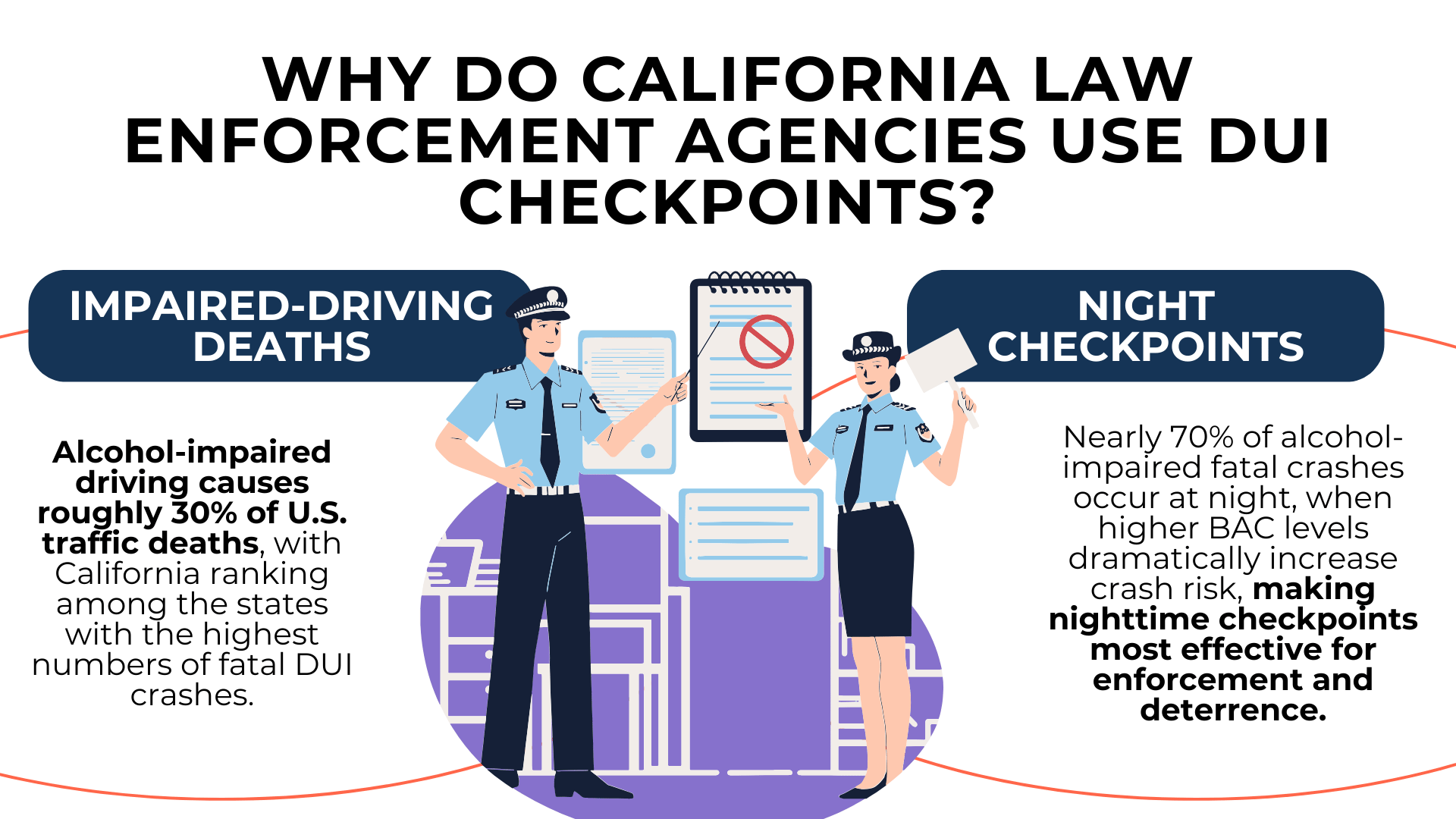
Impaired driving remains one of the leading causes of traffic fatalities. According to NHTSA (2025), 12,429 people died in alcohol-impaired driving crashes nationwide in 2023—approximately one death every 42 minutes. The same source reports that 30% of all traffic crash fatalities in the United States involve drunk drivers.
California’s numbers reflect this national crisis. The state consistently ranks among those with the highest raw counts of alcohol-impaired fatalities, making DUI enforcement a significant public safety priority.
Why are checkpoints often conducted at night?
Checkpoint timing reflects crash data. According to NHTSA’s 2023 Alcohol-Impaired Driving Data, 69% of alcohol-impaired fatal crashes occur at night. This concentration of nighttime risk explains why law enforcement agencies typically deploy checkpoints during evening and late-night hours, particularly on weekends and holidays.
The risk multiplier is also significant. NHTSA data shows that drivers with a BAC of 0.08% are approximately 4 times more likely to crash than sober drivers. At 0.15% BAC, crash risk increases at least 12-fold. Checkpoints serve both an enforcement and deterrent function, particularly during high-risk periods.
When Should You Challenge a DUI Checkpoint Stop?
Not every checkpoint meets constitutional requirements. If you were arrested at a checkpoint, certain circumstances may warrant a closer examination of whether the stop was lawful.
What are warning signs that a checkpoint may have been unlawful?
Consider whether any of these issues were present during your stop:
- No visible supervisory personnel or evidence that field officers were making operational decisions independently
- Apparently random vehicle selection rather than a neutral, predetermined formula (every car, every fifth car, etc.)
- Extended detention without any basis—being held for an unreasonably long time before contact with an officer
- Lack of official indicia—no signs, unmarked vehicles, officers not in uniform, poor lighting or safety measures
- No advance publicity and an unusual or unexpected location without apparent connection to DUI incident patterns
How do you document potential checkpoint violations?
If you believe a checkpoint may have been improperly conducted, preserve any evidence you can. Note the location, time, approximate duration of your stop, whether you saw supervisory personnel, how vehicles appeared to be selected, and any other observations about the checkpoint’s operation. Passengers can be valuable witnesses.
An attorney can subpoena checkpoint operational plans, supervisory logs, and other documentation to evaluate whether the Ingersoll requirements were satisfied. If significant deficiencies emerge, that analysis may support a motion to suppress evidence.

Frequently Asked Questions
Do police have to announce DUI checkpoints in advance?
Advance publicity is one of the eight Ingersoll factors, but it is not strictly required for a checkpoint to be constitutional. Courts consider it as part of the totality of circumstances. Most California agencies do publicize checkpoints, both because it satisfies Ingersoll and because advance notice serves the deterrent purpose of checkpoints.
How long can police detain you at a DUI checkpoint?
Detention must be brief. The Ingersoll framework requires minimal detention time, meaning officers should quickly assess whether further investigation is warranted and release drivers who show no signs of impairment. Extended detention without developing reasonable suspicion of impairment may exceed constitutional bounds.
Are DUI checkpoints legal under federal law?
Yes. The U.S. Supreme Court upheld the constitutionality of sobriety checkpoints in Michigan Dept. of State Police v. Sitz, 496 U.S. 444 (1990), finding that the government’s interest in preventing drunk driving outweighs the minimal intrusion of a brief checkpoint stop. California’s Ingersoll framework provides additional state-law requirements beyond the federal minimum.
Can passengers be questioned at a DUI checkpoint?
Officers may make observations about passengers and may ask questions, but passengers are not the focus of DUI checkpoints. Passengers are not required to provide identification absent reasonable suspicion of criminal activity. However, if officers observe evidence of other crimes in plain view, that may change the analysis.

Conclusion
DUI checkpoints are legal in California, but their constitutionality depends on strict adherence to the Ingersoll v. Palmer framework. Supervisory planning, neutral vehicle selection, adequate safety measures, reasonable location and timing, advance publicity, visible official markers, and minimal detention are all requirements that distinguish lawful checkpoints from unconstitutional seizures.
If you were stopped at a checkpoint, you retain important rights—including the right to refuse field sobriety tests and the preliminary breath test (for most drivers) without statutory penalty. And if the checkpoint itself failed to meet constitutional requirements, the evidence obtained during that stop may be subject to suppression.
If you were arrested at a DUI checkpoint and have questions about whether the stop was lawful, contact Randhawa Law Firm to discuss your situation.


