

A DUI arrest sets two separate legal processes into motion, and your arraignment marks the beginning of the criminal case. According to the California DMV DUI Management Information System Annual Report (2022), California recorded 124,141 DUI arrests in 2019 alone—each one leading to an arraignment hearing where defendants learn the charges against them and make their first critical decisions. Understanding what happens at a DUI arraignment in California helps you prepare for this court appearance and avoid mistakes that could affect the outcome of your case.
The arraignment is not a trial. No evidence is presented, and no determination of guilt occurs. Instead, this hearing serves specific procedural purposes that protect your constitutional rights while moving your case forward through the court system. What you decide at arraignment—particularly how you plead—shapes everything that follows.
What Is a DUI Arraignment in California?
A DUI arraignment is your first formal appearance before a judge in the criminal case resulting from your arrest. This hearing exists to ensure you understand the charges filed against you and to protect your constitutional right to notice of accusations before the government proceeds against you.
What is the purpose of an arraignment hearing?
The arraignment serves three core functions in California’s criminal process. First, the court formally notifies you of the specific charges the prosecutor has filed. Second, the judge advises you of your constitutional rights, including the right to an attorney. Third, the court takes your plea and addresses bail or release conditions. This hearing establishes the procedural foundation for everything that follows in your case.
How soon after arrest does arraignment occur?
If you remained in custody after your DUI arrest, California law requires arraignment within 48 hours, excluding weekends and holidays. Most DUI defendants, however, are cited and released at the scene or from the station. In these cases, your citation includes a future court date—typically four to six weeks after arrest—when you must appear for arraignment. This date is mandatory; failure to appear results in a bench warrant.
Is a DUI arraignment different for misdemeanors and felonies?
The basic arraignment procedure remains similar, but the stakes and court assignment differ. According to the California DMV DUI-MIS Report (2022), 95.6% of DUI arrests result in misdemeanor charges, meaning most defendants face arraignment in the misdemeanor division of Superior Court. The remaining 4.4% involve felony charges—typically fourth offenses within ten years or DUI causing injury—which proceed through felony arraignment with the possibility of a preliminary hearing to follow.

What Charges Will You Face at a California DUI Arraignment?
California DUI law allows prosecutors to charge you under two independent legal theories arising from the same arrest. Understanding both charges helps you comprehend what the prosecutor must prove and why most defendants face multiple counts at arraignment.
What does “driving under the influence” under VC 23152(a) mean?
Vehicle Code § 23152(a) prohibits driving while impaired by alcohol. Under this impairment theory, the prosecutor must prove that alcohol affected your mental or physical abilities to the point where you could not operate a vehicle with the caution of a sober person exercising ordinary care. This charge does not require a specific blood alcohol level—it focuses on observable impairment through driving patterns, physical symptoms, and field sobriety test performance.
What is a “per se” DUI charge under VC 23152(b)?
Vehicle Code § 23152(b) establishes the per se violation: driving with a blood alcohol concentration of 0.08% or higher. Under this theory, the prosecutor need only prove your BAC met or exceeded the legal threshold at the time of driving. Your actual driving ability is irrelevant—the number alone establishes the violation. This is why chemical test results play such a central role in most DUI prosecutions.
Why are most people charged with both counts?
Prosecutors routinely file both charges because each theory provides an independent path to conviction. The California DMV (2022) reports that 124,141 DUI arrests occurred statewide in 2019, and the dual-charge approach gives prosecutors flexibility if evidence supporting one theory proves weaker than expected.
For each charge, the prosecution must establish specific elements:
- For VC 23152(a) impairment DUI:You were driving, you had consumed alcohol, and alcohol impaired your ability to drive with ordinary care
- For VC 23152(b) per se DUI:You were driving, and your BAC was 0.08% or higher at the time of driving
- For both charges:The driving occurred on a public road or highway in California
- Timing element:The BAC level existed at the time of driving, not merely at the time of testing
Despite facing two charges, conviction on both counts arising from a single incident constitutes one DUI offense for sentencing purposes under California law.

What Happens During the Arraignment Hearing?
The arraignment follows a structured sequence designed to protect your rights while efficiently processing cases through the court system. Knowing what to expect removes uncertainty and helps you focus on the decisions that matter.
What rights will the judge explain?
Before taking any plea, the judge must ensure you understand your constitutional protections. The court will advise you of these fundamental rights:
- Right to an attorney:You may hire a lawyer or, if you cannot afford one, request court-appointed counsel
- Right to a speedy trial:The case must proceed within statutory time limits unless you waive this right
- Right to confront witnesses:You may cross-examine anyone who testifies against you
- Right against self-incrimination:You cannot be forced to testify against yourself
- Right to present a defense:You may call witnesses and present evidence on your behalf
- Right to a jury trial:You may have a jury decide your guilt or innocence
The judge will ask whether you understand each right. This is not a formality—these protections shape your entire case strategy.
Will bail be set at the arraignment?
For most misdemeanor DUI defendants who were cited and released, bail is not a significant issue at arraignment. You typically remain released on your own recognizance (OR) with conditions such as abstaining from alcohol and not driving without a valid license. Felony DUI cases or situations involving injury, high BAC, or prior failures to appear may result in bail being set or increased. The California DMV (2022) indicates that 68.9% of DUI arrests ultimately result in conviction, but bail decisions focus on ensuring court appearance and public safety, not likelihood of conviction.
What happens after the judge reads the charges?
Once the court has read the charges and confirmed you understand your rights, the judge will ask how you plead. You have three options: guilty, not guilty, or no contest. Most defendants enter a not guilty plea at arraignment, preserving their options while their attorney reviews the evidence. The judge then sets dates for future proceedings—typically a pretrial conference—and confirms any release conditions.
How long does an arraignment hearing take?
Individual arraignments typically last five to fifteen minutes. However, expect to spend several hours at the courthouse. Courts often schedule dozens of arraignments on the same calendar, and you may wait while other cases are called. Arriving on time is essential—late arrival can result in a bench warrant.

What Are Your Plea Options at a DUI Arraignment?
The plea you enter at arraignment has immediate and lasting consequences. Understanding your options—and why most defendants initially plead not guilty—helps you make an informed decision.
Should you plead not guilty at arraignment?
Entering a not guilty plea is standard practice at arraignment, even for defendants who may eventually accept responsibility. This plea preserves all your options: your attorney can review police reports, challenge evidence through pretrial motions, and negotiate with the prosecutor. According to the California DMV (2022), some DUI cases are reduced to “wet reckless” (alcohol-related reckless driving)—a reduction only possible through negotiation that requires time after arraignment.
A not guilty plea is not a lie. It simply means you require the prosecution to prove its case and are not waiving your right to examine the evidence before making any admissions.
What is the difference between guilty and no contest pleas?
Both guilty and no contest (nolo contendere) pleas result in conviction and identical criminal penalties. The difference involves civil liability: a guilty plea can be used against you in a civil lawsuit arising from the same incident, while a no contest plea generally cannot. If your DUI involved a collision where civil claims might follow, this distinction matters.
Can you get diversion for a DUI in California?
No. California Vehicle Code § 23640 expressly prohibits judicial diversion for DUI offenses. In Grassi v. Superior Court, 73 Cal.App.5th 283 (2021), the court confirmed that DUI cases are categorically excluded from the general diversion provisions of Penal Code § 1001.95. The court in Tan v. Superior Court, 76 Cal.App.5th 130 (2022), reinforced this holding. Unlike some other misdemeanors, DUI cannot be diverted—the case must proceed through the criminal process to resolution.
What happens if you plead guilty at arraignment?
Pleading guilty at arraignment waives multiple rights and typically results in immediate sentencing. The California DMV (2022) shows that probation is a standard part of DUI sentencing. Entering a guilty plea without reviewing evidence means accepting consequences that include:
- Immediate convictionon your criminal record
- Probation termsof three to five years under Vehicle Code § 23600
- DUI school enrollmentrequirement (3-month program for first offense)
- Fines and feestotaling $1,500 to $2,500 or more
- Potential jail timedepending on case factors and judicial discretion
Guilty pleas entered at arraignment forfeit the opportunity to challenge the stop, the arrest, or the chemical test results.

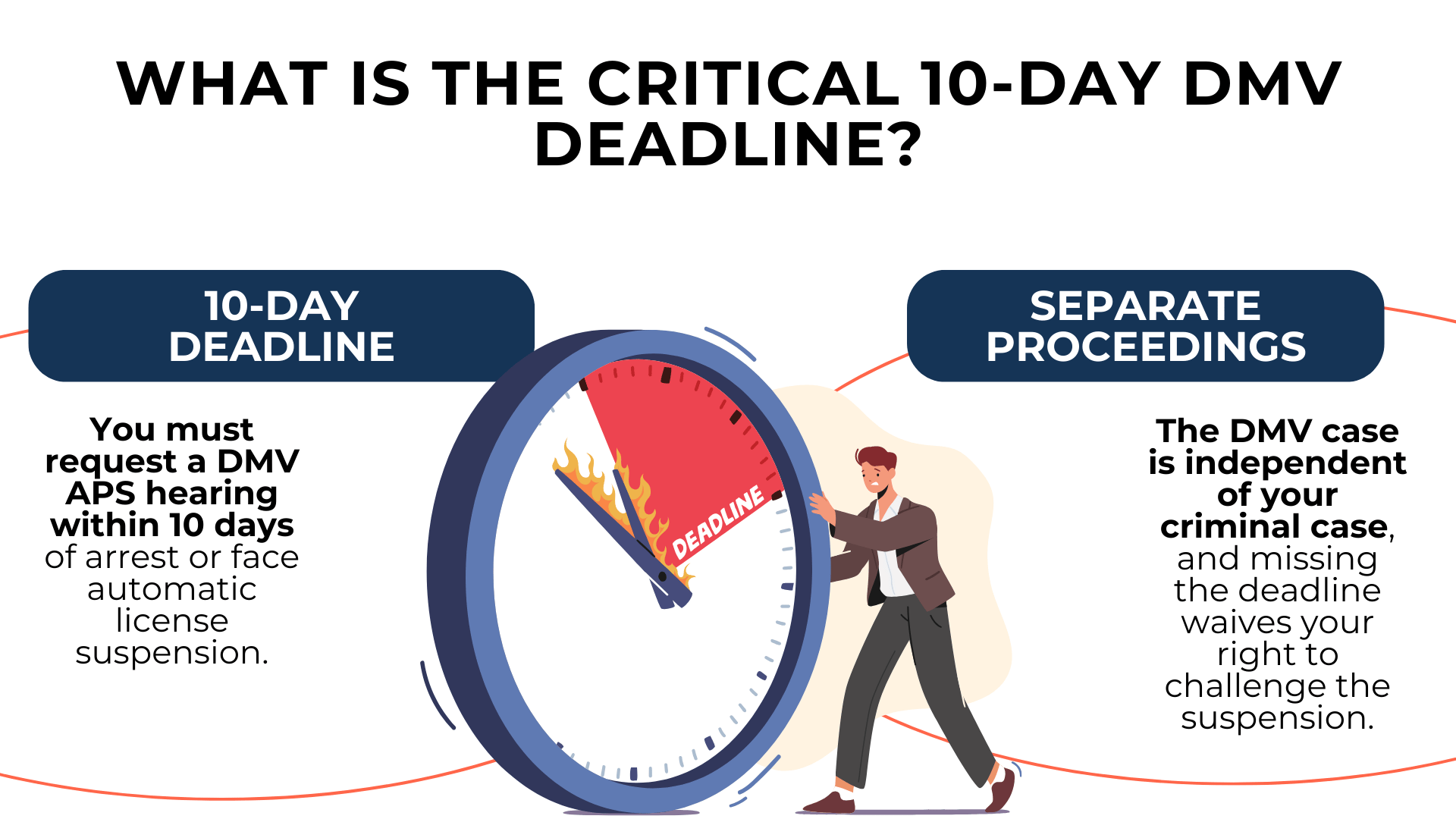
What Is the Critical 10-Day DMV Deadline?
Your arraignment date addresses only the criminal case. A completely separate administrative proceeding at the DMV threatens your driving privileges on a different timeline—one that often expires before your first court date.
Why does the DMV deadline matter if you have a court date?
When you were arrested for DUI, the officer confiscated your license and issued a temporary permit. That permit expires in 30 days, and your license faces automatic suspension unless you request an Administrative Per Se (APS) hearing. The California DMV (2022) tracks these APS actions, each of which follows an arrest where the driver’s license is at stake regardless of the criminal case outcome.
Under Vehicle Code § 13558, you have only 10 days from your arrest date to request this hearing. Your arraignment date, which may be four to six weeks away, has no bearing on this deadline.
What happens if you miss the 10-day deadline?
Failing to request an APS hearing within 10 days waives your right to contest the administrative suspension. Your license will be automatically suspended 30 days after arrest, and you lose the opportunity to challenge the DMV’s action or potentially obtain a stay of the suspension while the hearing is pending. The California DMV (2022) documents 157,868 total license suspension and revocation actions in 2020, combining both APS and court-ordered suspensions.
How do the criminal case and DMV case relate to each other?
These proceedings operate independently under different legal standards. The criminal court requires proof beyond a reasonable doubt; the DMV uses preponderance of the evidence. As the California Supreme Court held in Lake v. Reed, 16 Cal.4th 448 (1997), the APS suspension is a civil remedial measure, not punishment—meaning acquittal in criminal court does not automatically restore your license. You must succeed in both proceedings to avoid all consequences.
What Happens After the Arraignment?
Arraignment marks the beginning, not the end, of your DUI case. Understanding the typical timeline helps you plan for what comes next.
What is a pretrial conference?
After arraignment, the court schedules a pretrial conference—a hearing where your attorney and the prosecutor discuss the case, exchange evidence (discovery), and explore potential resolution. This is often where plea negotiations occur. According to the California DMV (2022), 20.5% of DUI arrests showed no corresponding conviction on DMV records, reflecting cases dismissed, reduced below DUI, or otherwise resolved favorably.
How long does a DUI case take to resolve?
Most misdemeanor DUI cases resolve within three to six months from arraignment, though cases involving contested issues may take longer. The California DMV (2022) shows that 72.8% of convicted offenders are first-time defendants navigating this process for the first time.
When do plea negotiations typically happen?
Negotiations generally occur after your attorney reviews discovery but before trial. The timeline typically proceeds through these stages:
- Arraignment: Formal charges read, not guilty plea entered, first pretrial date set
- Discovery period: Defense receives police reports, chemical test records, video evidence
- Pretrial conferences: Negotiations occur, motions may be filed
- Motion hearings: Challenges to evidence heard if filed
- Resolution or trial setting: Case resolves through plea or proceeds toward trial
Most cases resolve at the pretrial stage through negotiated pleas. Cases proceeding to trial represent a small minority of total DUI prosecutions.

Frequently Asked Questions
Can I represent myself at a DUI arraignment?
Yes, you have the constitutional right to represent yourself, and the judge will advise you of this right at arraignment. However, the court will also warn you of the risks of self-representation in a criminal case. Many defendants enter a not guilty plea at arraignment specifically to allow time to consult with an attorney before making decisions that affect the outcome of their case.
What if I miss my arraignment date?
Failing to appear at your scheduled arraignment results in a bench warrant for your arrest under California Vehicle Code § 40508. The court may also impose bail forfeiture if you posted bond. Missing your court date creates additional legal problems on top of the original DUI charge and should be avoided.
Will I go to jail at my arraignment?
Most misdemeanor DUI defendants who were cited and released after arrest remain free through arraignment on their own recognizance. Judges typically impose release conditions such as not consuming alcohol and not driving without a valid license. Custody is more likely for felony DUI charges, cases involving injury, or defendants with prior failures to appear.
How is a DUI arraignment different from a DMV hearing?
The arraignment is a criminal court proceeding that addresses potential jail time, fines, probation, and a criminal record. The DMV hearing is an administrative proceeding focused solely on whether to suspend your driving privileges. These processes run parallel under different rules, and success in one does not guarantee success in the other.
Can my case be dismissed at arraignment?
Dismissal at arraignment is rare. This hearing is procedural—designed to inform you of charges and take your plea, not to evaluate evidence. Dismissals typically occur later in the process through pretrial motions, evidentiary challenges, or prosecutorial decisions after reviewing the strength of the case.

Moving Forward After Arraignment
Your DUI arraignment is the first step in a process that will unfold over the coming months. The decisions you make at this hearing—particularly your plea—set the course for everything that follows. Entering a not guilty plea preserves your ability to challenge evidence, negotiate with the prosecutor, and make informed decisions after reviewing the facts of your case.
Remember that the 10-day DMV deadline runs from your arrest date, not your arraignment. This separate administrative proceeding requires immediate attention regardless of when your criminal case is scheduled.
If you have questions about your upcoming DUI arraignment, contact Randhawa Law Firm to discuss your situation.


